

A $5,000 check seems straightforward until the IRS enters the equation. Thousands of New Yorkers who scratch a winning ticket every year discover that the final amount in their pocket depends on an exact threshold few know before cashing in. That magic number—$5,000—decides whether tax authorities automatically withhold a portion before you see a single dollar.
Quick Answer
If your ticket won exactly $5,000, federal tax will technically not be withheld at 24% immediately, as IRS rules apply only when net winnings exceed that amount. However, that income remains fully taxable when you file your annual tax return. Factor in state taxes—which range from 0% to 10.9% depending on where you live—and expecting a total tax burden between 24% and 35% of the gross prize is realistic.
How Much Tax Do You Have to Pay on a $5,000 Lottery Ticket? Tax Breakdown
The most common point of confusion is mixing up two distinct concepts: immediate withholding applied by the payer and your actual tax liability calculated when filing your tax return.
Withholding is merely a partial prepayment toward taxes; your true obligation depends on your total annual income bracket.
Many winners believe that if nothing was withheld at payout, they owe nothing to the IRS—a belief that can cost them dearly come April.
The final impact of how much tax you have to pay on a $5,000 lottery ticket depends directly on your state of residence and your federal tax bracket.
A New York resident will pay significantly more than a Florida resident, even when winning the exact same amount.
Below is a detailed breakdown of how those percentages are split among federal, state, and, in some cases, municipal governments.
Federal Withholding vs. State and Local Taxes on Lottery Winnings
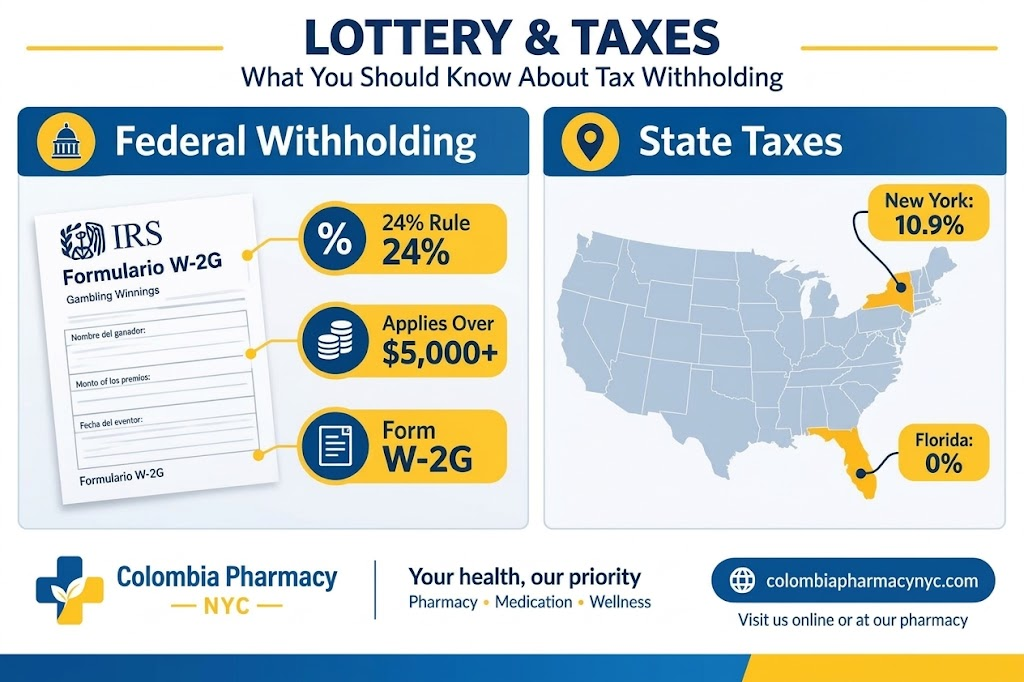
Form W-2G is the key document the lottery payer issues when a prize qualifies for withholding or simply to report the winnings to the IRS. According to Section 3402(q) of the tax code, automatic 24% withholding applies when “proceeds”—meaning the prize minus the cost of the ticket—are more than $5,000, not when they are equal to that amount. This technical distinction is the exact reason why a ticket for exactly $5,000 may arrive intact in your hands, even though you still owe taxes on it later.
At the state level, variations are massive. New York imposes up to 10.9% on lottery winnings—one of the highest rates in the nation—while states like Florida, Texas, or Washington charge no state income tax at all. Certain cities, including New York City and Yonkers, add a small additional local tax on their residents’ income, further increasing the final tax bill. Combining these three levels—federal, state, and municipal—the total tax burden can range from 24% to 35% of the gross prize, depending entirely on your zip code.
| Tax Component | When It Applies | Approximate Rate |
| Automatic federal withholding | Prizes over $5,000 | 24% |
| Federal tax upon filing | Every prize, no exempt minimum | 10% to 37% depending on bracket |
| State tax (NY example) | Every lottery prize | Up to 10.9% |
| State tax (FL example) | Every lottery prize | 0% |
“The 24% withholding is not the final tax; it is merely an advance payment adjusted according to your actual tax bracket when filing.”
How to Report Your Winnings on Your Tax Return (Form 1040)
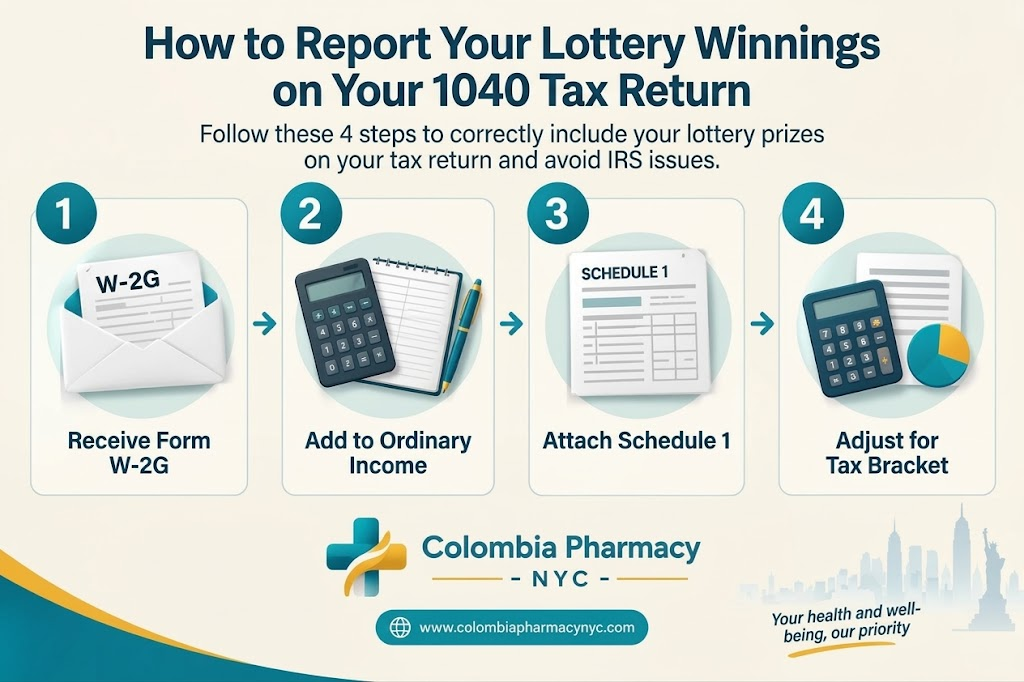
Regardless of whether taxes were withheld upfront, your prize must be added to your annual gross income on Schedule 1 of Form 1040, under the “Other Income” line. The payer typically provides you with a copy of Form W-2G detailing the exact winnings, and the IRS receives a matching copy, making unreported lottery income easily detectable during an audit.
There is a legitimate way to reduce part of the tax impact: if you itemize deductions on Schedule A instead of taking the standard deduction, you can deduct documented gambling losses, but only up to the total amount of your reported gambling winnings for that year. You cannot use gambling losses to reduce other types of income, such as wages or bank interest.
Finally, the true adjustment occurs when your prize is combined with the rest of your annual income: if your marginal bracket is 22% or 24%, a $5,000 prize can generate $1,100 to $1,200 in federal tax on that ticket alone, plus applicable state and local amounts.
Conclusion
Winning $5,000 in the lottery is an exciting event, but understanding the difference between immediate withholding and actual tax liability prevents unpleasant surprises months later. The threshold rule—withholding applies only if the prize exceeds, rather than equals, $5,000—confuses many winners who mistakenly assume they owe nothing to the IRS. Consulting with a tax preparer or a professional CPA before filing your return is the safest way to calculate what you owe and avoid penalties or interest from incomplete reporting.
Disclaimer Note: This article is for general informational purposes regarding taxes and does not constitute personalized legal, tax, or medical advice. Always consult a Certified Public Accountant (CPA) for your specific tax situation, and a qualified healthcare professional or pharmacist for any health-related questions. For pharmacy and vaccination options, learn more at the Servicios de Farmacia y Vacunación section of Colombia Pharmacy.
Key Takeaways
- A prize of exactly $5,000 does not trigger automatic 24% federal withholding, but it remains fully taxable income.
- Prizes over $5,000 require mandatory 24% federal withholding under Form W-2G rules.
- State tax rates vary widely: from 0% in Florida or Texas to up to 10.9% in New York State.
- Total combined tax burden (federal + state + local) can reach 30% to 35% in high-tax jurisdictions.
- All lottery winnings must be declared on Schedule 1 of Form 1040, regardless of the prize amount.
- Gambling losses are only deductible if you itemize on Schedule A, capped at your total reported gambling winnings.
Frequently Asked Questions
Does an undocumented resident or non-resident pay a different federal withholding rate when winning $5,000?
Yes. Non-resident aliens generally face a 30% federal withholding rate on gambling winnings instead of the 24% rate applied to US citizens and permanent residents. This higher rate applies regardless of the exact prize amount and is typically reported on Form 1042-S rather than the standard W-2G.
Can non-winning lottery tickets be deducted to lower taxes on a $5,000 prize?
Yes, but under strict conditions. The cost of losing tickets purchased during the same tax year is considered a deductible gambling loss only if you itemize deductions on Schedule A, and total deductible losses cannot exceed your total reported gambling winnings for that year.
What happens if the prize is $4,999 instead of an exact $5,000?
In that case, the prize sits clearly below the threshold for automatic 24% withholding, so the payer will not withhold taxes upfront and may not issue a Form W-2G. However, you are still legally required to declare that income on your annual tax return regardless of how small the amount is.